I wouldn't work there
This may be the most millennial thing I've ever said. Join my keyword research masterclass and Battenhall's social media report for 2022.

Unlike many freelancers the thought of being an employee again one day doesn’t feel me with dread. I believe in, and have been lucky enough to experience, a boomerang career - freelancing for four years, back in-house for two, then back to freelance life again for the past three years.
Which means that while I’m very happy offering services on a freelance basis now, I do still scroll through the odd job ad for “Head of Content” or the like.
In doing this I realise I’ve unconsciously developed a set of criteria which rules in (or out) the types of companies I’d like to work for.
A few years back the biggest draw for me would have been:
Working with or for someone I admired and who had an exciting vision (usually a company owner or Founder)
The chance to try new things
A good learning budget which meant I could attend events or take courses to upskill
Which makes total sense when you think that I was in the “growth and learning” phase of my career.
Today, my list of criteria looks wildly different. As I imagine it does for many, given what we’ve learned about ourselves and what matters in these post-pandemic years.
Today, when I read a job ad I find I’m looking for:
A diverse leadership team - Many companies claim to be diverse but usually a quick scan of the team page shows that this is only at the junior level of the company. Representation is so important and I’ve felt first-hand the repercussions it has on junior team members when they don’t see themselves represented at leadership level
True flexibility - this is something I prized before 2022 and was lucky to have in my last role. Again, most companies will claim to be flexible (especially now) but when you read between the lines what they actually mean is you can work from home but must be at your desk 9-5 every day. I’ve believed for a long-time, (and studies on knowledge work back this up) that humans aren’t built to sit and work for eight hours a day. For me, true flexibility means being able to build my schedule around the hours and times of day I work best so long as I get the job done. Obviously this isn’t possible in certain roles like customer support, but if a company claims to offer flexibility this needs to be more than just normal work, but at home.
A two-way partnership - I’ve always loved work. From working on an ice cream van at 16, to being a Head of Marketing, I get passionate about helping to execute someone’s vision. Even in industries that wouldn’t traditionally be viewed as “glamorous”. But what makes me close a job ad down is when a company asks so much of a candidate without offering an equal amount in return. I see so many that mostly tell you what skills you need, before listing “remote Fridays” and “competitive salary” as benefits. Every job should be a partnership between employer and employee, with both of you willing to invest equally.
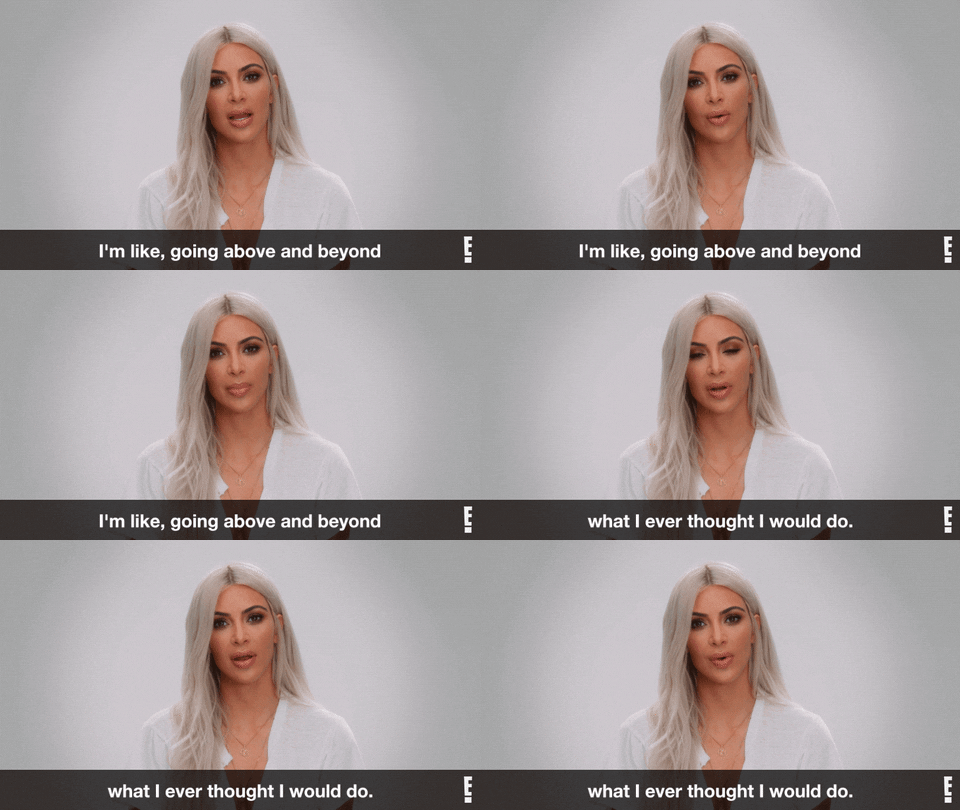
We’re told it’s a jobseekers’ market right now but unfortunately not many job ads reflect this.
So if you were returning in-house or searching for a new role, what would your top three criteria be? I’d love to hear.
Yours (not looking for fulltime employment thankfully),
Beth
Want to learn how to do keyword research with me?
In January I’m hosting a one-hour masterclass teaching how I do keyword research from start to finish. This is the exact process I use for client projects that has helped them to dominate their category in search and find clever ways to still get leads from Google, even in competitive areas. See details here.
I’ll be covering:
How to begin by setting out your content buckets
How and why I do light keyword research first
How to use free tools to find keyword information
How to interpret keyword information
How to organise keywords into your website pages and blogposts
The reason I’m so keen to share my process is because I know what it’s like to get totally lost in spreadsheets and keyword research tools without really making progress or knowing how to apply what you’re seeing to an SEO strategy. In this workshop I want to provide a process anyone can follow to make sense of it all and create a keyword strategy that actually works!
Tickets are £35 with the recording and slides shared after the masterclass and I’d love for you to join me.
Interesting reads & links 🧐
Google’s 100 holiday gift ideas based on Google searches is an interesting read on what products have trended this year
I’m sharing 12 truths of Christmas on my Instagram over December with things I’ve learned from a career as a freelance marketer. They’re pretty juicy but I’ve been inspired by the truth and authenticity of TikTok as a platform and wanted to bring a bit of that to my channel!
Battenhall has released its 100 brands on Instagram and TikTok report analysing trends across the platforms. Top takeaways below but bear in mind the accounts analysed are large brands (Nike, Emirates, Microsoft etc.) so it’s not the best report to benchmark by unless that’s also your category.
Hashtags do still matter on Instagram and increase engagement from an average of 0.25% to 1%. Insta experts have been saying this anecdotally for a while and I definitely find they help me reach more non-followers.
Fashion content on TikTok is predominantly made by influencers rather than brands (which is how Insta started too)
Brands in Fashion, Sport, Entertainment and Transport post multiple times per day on Instagram, whereas other industries all post less than once per day (Food & Drink, B2B, Gaming etc.). On TikTok almost all brands are publishing less than once per day.
TikTok outperforms Instagram in terms of engagement per follower count
Thank you for reading ❤️

Hi! I’m Beth. I’ve spent my career building marketing strategies & managing marketing teams, mainly in the B2B technology space. Today, I’m a freelancer who creates and manages SEO & content strategies for companies who want to grow organically.
Services I offer can be found on My website or Built by Content